Seeing animals in a dream in Islam can carry spiritual meaning, but not every animal dream is significant. Islam teaches that dreams fall into three categories: true dreams (ru’ya) from Allah, disturbing dreams (hulm) from Shaytan, and dreams from your own thoughts (hadith al-nafs). The meaning depends on the type of dream type, the animal’s behavior, your emotional state, and your life circumstances, not the animal alone.
- True dreams feel vivid, clear, and leave peace upon waking
- Disturbing dreams cause fear, anxiety, or darkness seek refuge in Allah
- Dreams from the nafs reflect daily stress, desires, or random thoughts
Introduction
Dreams have intrigued humanity since the beginning of time, and in Islam, they hold a special place. The Prophet Muhammad ﷺ said, “Nothing is left of prophethood except glad tidings,” and when asked what those were, he replied, “True dreams” (Sahih Muslim).
Yet many Muslims feel confused, anxious, or even frightened when they see animals in their dreams unsure whether the dream carries a message from Allah, a trick from Shaytan, or simply the noise of their own mind.
At Muslim Dreams And Interpretations, we believe no Muslim should lose sleep over uncertainty. This guide gives you the complete Islamic framework for understanding animal dreams grounded in the Quran, authenticated Hadith, and the classical scholarly tradition of ta’bir al-ru’ya.
Unlike generic dream dictionaries that assign fixed meanings without context, we teach you the 5-Step Islamic Method used by scholars like Imam Ibn Sirin to interpret dreams with wisdom, restraint, and spiritual balance.
Whether you dreamed of a lion chasing you, a snake hiding in the shadows, a horse running free, or animals you cannot even name this guide will show you exactly how to understand what your dream means, what to do next, and when to simply let it go.
The 3 Types of Dreams in Islam Every Muslim Must Know
Islam categorizes dreams into three types: ru’ya (true dreams from Allah, often vivid and peaceful), hulm (disturbing dreams from Shaytan, causing fear and anxiety), and hadith al-nafs (dreams from your own thoughts and daily experiences). Identifying which type you experienced is the first and most important step before seeking any meaning.
Ru’ya True Dreams from Allah (Rahmani)
A true dream (ru’ya) is a gift from Allah and a remnant of prophethood. These dreams are characteristically vivid, coherent, and leave a lingering sense of peace, awe, or spiritual weight upon waking. They may offer guidance, warn of danger, or bring glad tidings.
The Prophet ﷺ experienced true dreams before revelation began, and he taught his companions to value them. If your animal dream felt clear, meaningful, and left you with sakinah (tranquility), it may fall into this category. However, even true dreams require proper interpretation; they are not self-explanatory.
Hulm Disturbing Dreams from Shaytan (Shaytani)
A hulm is a disturbing or frightening dream sent by Shaytan to cause fear, anxiety, or spiritual confusion. These dreams often feel chaotic, dark, or emotionally jarring. If you wake from an animal dream feeling terrified, shaken, or unsettled, the Islamic response is clear: seek refuge in Allah.
The Prophet ﷺ taught us to spit lightly to the left three times, say “A’udhu billahi min al-shaytan al-rajim,” and not to share the dream with anyone. Performing wudu and offering two rak’ahs of prayer is also recommended. These dreams carry no prophetic meaning they are spiritual attacks to be repelled, not interpreted.
Hadith al-Nafs Dreams from Your Own Thoughts
The third category comes from your own nafs, your thoughts, fears, desires, and daily experiences. If you watched a documentary about lions, discussed a friend’s pet, or felt anxious about a situation, your mind may process this during sleep. These dreams are not spiritually significant. They reflect your mental and emotional state, not divine communication. The key sign of a nafs dream is that it feels random, disconnected from your spiritual life, and lacks emotional weight upon waking. Most animal dreams fall into this category.
The 5-Step Islamic Method to Interpret Animal Dreams Correctly
The correct Islamic method for interpreting animal dreams involves five steps: (1) identify the dream type, (2) analyze the animal’s behavior, (3) notice your emotional state upon waking, (4) connect the dream to your real-life circumstances, and (5) consult qualified scholarly sources. This framework prevents misinterpretation and protects you from spiritual confusion.
Step 1 Identify the Dream Type Before Any Symbol
Before you ask what a lion or snake means, determine whether your dream was a ru’ya, hulm, or hadith al-nafs. This single step eliminates the majority of misinterpretation. A terrifying animal attack dream from Shaytan does not need symbolic analysis, it needs the Sunnah response. A peaceful dream of birds flying may carry meaning, but only if it meets the criteria of a true dream.
Step 2 Analyze the Animal’s Behavior and Action
In classical Islamic dream literature, behavior matters more than species. A calm lion carries a different meaning than an attacking lion. A snake you kill differs from a snake that bites you. Scholars like Ibn Sirin consistently prioritized what the animal did over what the animal was. Document the action: Did it chase, guide, speak, stand still, or die?
Step 3 Notice Your Emotional State Upon Waking
Your feelings upon waking are one of the clearest indicators of a dream’s nature. Sakinah (tranquility) suggests a true dream. Fear and anxiety suggest a hulm. Indifference suggests hadith al-nafs. Do not dismiss this emotional data the Prophet ﷺ and the Sahaba used it as a primary diagnostic tool.
Step 4 Connect the Dream to Your Real-Life Circumstances
A dream interpreter is not a prophet and cannot tell the future. Imam Ibn Sirin spent hours questioning dreamers about their lives, work, relationships, and spiritual state before offering any interpretation. Your current circumstances conflict, health, marriage, travel, grief provide the context that gives symbols meaning. Never interpret in isolation.
Step 5 Consult Scholarly Sources, Not Guesswork
True interpretation requires knowledge, taqwa (God-consciousness), and understanding of Islamic tradition. Consult qualified scholars, authenticated texts, or reputable Islamic dream resources. Avoid social media guesswork, generic dream apps, or unqualified individuals who memorized symbol lists without scholarly training.
What Shapes the Meaning of an Animal in Your Dream?
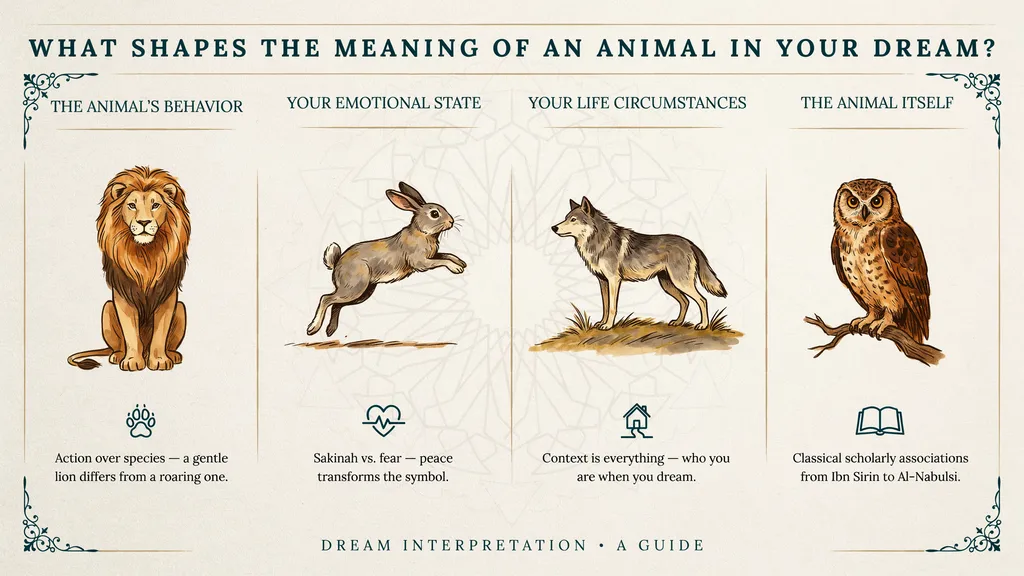
Four factors shape the meaning of an animal in an Islamic dream: the animal’s behavior (action over species), your emotional state upon waking (sakinah vs. fear), your current life circumstances (context is essential), and the animal’s classical scholarly associations (drawn from Quran, Hadith, and ta’bir tradition). No single factor works alone.
The Animal’s Behavior Action Over Species
A lion standing calmly represents authority at a distance. The same lion attacking represents a hostile force. A dog barking warns of enemies; a calm dog symbolizes loyalty. Classical scholars consistently taught that how the animal behaves shapes the meaning far more than what the animal is. Always document the action first.
Your Emotional State Sakinah vs. Fear
The Prophet ﷺ and his companions used emotional state as a primary filter. True dreams bring peace. Disturbing dreams bring fear. Your gut feeling upon waking is not arbitrary it is a spiritual diagnostic tool that Islam has validated for over 1,400 years. Trust it.
Your Life Circumstances Context Is Everything
Imam Ibn Sirin would spend a full day investigating a dreamer’s life before interpreting. Why? Because a dream of a snake might mean a hidden enemy to a businessman, a health warning to someone ill, or simply anxiety to a student facing exams. Context transforms symbols into meaning.
The Animal Itself Classical Scholarly Associations
While behavior and context come first, the classical tradition does associate certain animals with specific themes. These associations come from centuries of scholarly reflection, Quranic imagery, and Hadith not from fixed dictionaries. Use them as starting points, not verdicts.
Lion Dreams in Islam: Power, Authority & Hidden Enemies
A lion in an Islamic dream typically symbolizes power, authority, courage, or a strong opponent. However, the lion’s behavior changes the meaning entirely: a calm lion reflects inner strength, a chasing lion reflects pressure you are escaping, an attacking lion warns of conflict, and riding a lion suggests authority gained. Context always matters.
| Dream Scenario | Islamic Interpretation | Tone |
| Lion chasing you | Fear, pursuit by powerful person/situation, pressure you are escaping | Warning |
| Lion standing calmly | Authority at a distance, inner strength, awe without threat | Mixed/Positive |
| Lion attacking | Hostile force, strong adversary, overwhelming pressure | Warning |
| Riding a lion | Authority gained, challenge mastered, power granted | Positive |
A Lion Chasing You Fear and Pursuit
When a lion chases you in a dream, it often reflects a powerful person, situation, or internal pressure you are trying to escape. This could be a difficult boss, a family conflict, or a spiritual struggle you have been avoiding. The dream is not necessarily a prediction, it may be your subconscious processing pressure. If the dream was vivid and left you with sakinah, consult a scholar. If it caused terror, follow the Sunnah response for bad dreams.
A Friendly or Calm Lion Inner Strength
A calm lion represents authority, dignity, and inner power that does not threaten you. This may reflect your own growing confidence, a position of respect you have earned, or a powerful figure in your life who means you no harm. Classical scholars often linked calm lions to legitimate leadership and noble strength.
A Lion Attacking Warning of Conflict
An attacking lion typically carries a warning tone. It may signal a hostile force in your life, a strong adversary, an overwhelming challenge, or a test of faith approaching. This does not mean harm is inevitable. Rather, it calls for preparation, prayer, and tawakkul (trust in Allah). Seek scholarly guidance if the dream felt spiritually weighty.
Riding a Lion Authority Gained
Riding a lion in a dream is a powerful symbol of mastery over difficulty. It suggests you have gained authority, overcome a major challenge, or been granted power and responsibility. Classical dream literature consistently links riding powerful animals to elevation in status, spiritual progress, or leadership.
Running Away from a Lion Escaping Pressure
Running from a lion reflects avoidance; you are fleeing from a pressure, responsibility, or conflict that needs confrontation. The dream may be calling you to face the situation with courage rather than continued escape. If the dream was peaceful despite the chase, it may indicate that Allah is preparing you for a test you will pass.
Snake Dreams in Islam: Deception, Enemies & Hidden Dangers
A snake in an Islamic dream often symbolizes hidden enemies, deception, danger, or jealousy from someone close. However, context changes everything: an attacking snake represents a direct threat, a snake you kill signifies overcoming adversity, and a harmless snake suggests a challenge you will surpass. Always analyze behavior first.
A Snake Attacking Direct Threat from an Enemy
An attacking snake in a dream typically represents a hidden enemy who has revealed themselves, a betrayal from someone close, or a danger you can no longer ignore. Classical scholars like Ibn Sirin consistently associated attacking snakes with adversaries who operate in secrecy. If this dream felt like a true dream (ru’ya), increase your vigilance in relationships and seek Allah’s protection.
Killing a Snake Overcoming Adversity
Killing a snake in a dream is one of the most positive animal dream symbols in Islam. It represents triumph over enemies, overcoming hidden dangers, and gaining victory through patience and faith. The Prophet ﷺ spoke of the virtue of killing harmful creatures, and this symbolism extends to dream interpretation.
A Harmless Snake Challenge You Will Surpass
A snake that does not attack one you observe from a distance or that passes by without incident may represent a challenge, temptation, or fear that appears threatening but holds no real power over you. This dream often comes to those facing anxiety about a situation that will resolve peacefully.
Horse, Bird, Dog & Cat Dreams What Each Animal Means
In Islamic dreams, horses symbolize honour and spiritual striving, birds represent freedom and divine messages, dogs reflect loyalty or warn of betrayal, and cats indicate intuition and independence. The specific meaning depends on behavior, your emotions, and life context not the animal alone. Use this table as a starting point, not a verdict.
| Animal | Common Islamic Association | Quranic/Hadith Root | Tone |
| Horse | Honour, dignity, momentum, noble striving | Surah Al-Adiyat 100:1-3 | Positive |
| Bird | Freedom, elevation, spiritual state, messages | Surah Al-Mulk 67:19 | Mixed |
| Dog | Loyalty, protection, or warning of betrayal | General scholarly tradition | Mixed |
| Cat | Intuition, independence, mystery, grace | General scholarly tradition | Mixed |
Horse Dreams Honour, Dignity and Spiritual Striving
Horses carry noble associations in Islam. Allah swears by the charging horses in Surah Al-Adiyat, and the Prophet ﷺ spoke of goodness being tied to horses in Sahih al-Bukhari. In dreams, horses represent honour, momentum, dignity, and beneficial striving. A freely running horse suggests spiritual progress. A confined or difficult horse may reflect challenges to your dignity or momentum.
Bird Dreams Freedom, Elevation and Divine Messages
Birds in Islamic dreams connect to movement, elevation, and spiritual condition. A flying bird often indicates good fortune and spiritual growth. A trapped bird may signal obstacles. The species matters greatly; a pigeon suggests peace, an eagle higher knowledge, while a crow may carry a darker tone in some classical readings. Surah Al-Mulk 67:19 references birds in symbolic contexts that shaped scholarly interpretation.
Dog Dreams Loyalty, Protection or Warning of Betrayal
Dogs in Islamic dreams are deeply contextual. A friendly, calm dog may represent a loyal companion, trustworthy friend, or protective force in your life. An aggressive or barking dog warns of enemies, false friendships, or betrayal from someone close. The behavior determines whether the dog is a positive symbol or a cautionary one.
Cat Dreams Intuition, Independence and Mystery
Cats in Islamic dream interpretation symbolize intuition, independence, and the ability to navigate life’s challenges with subtlety and grace. A playful cat suggests contentment and the need to nurture your personal space. A mysterious or aggressive cat may indicate hidden emotions, unresolved issues, or a situation requiring careful observation before action.
Animal Attack Dreams in Islam: What to Do and What They Mean
An animal attack dream in Islam usually carries a warning tone but does not automatically predict real harm. It may reflect fear, a hostile person, emotional pressure, or a disturbing dream (hulm) from Shaytan. The correct response is the Sunnah: seek refuge in Allah, spit lightly to the left three times, and do not share the dream.
Why Animal Attacks Appear in Dreams
Animal attacks in dreams often emerge from three sources: (1) a true dream warning of a real threat or hostile person, (2) a hulm from Shaytan designed to cause fear and anxiety, or (3) your nafs processing stress, conflict, or unresolved fear. The key is not to panic but to diagnose the source using the 5-Step Method.
The Sunnah Response to Disturbing Animal Dreams
When you wake from a disturbing animal dream, follow this Prophetic protocol exactly:
- Spit lightly to your left three times (Sahih Muslim)
- Say “A’udhu billahi min al-shaytan al-rajim” three times
- Do not tell the dream to anyone especially if it was frightening
- Turn to your other side and seek Allah’s protection
- Perform wudu and pray two rak’ahs if anxiety persists
- Recite Ayatul Kursi before sleeping to prevent recurrence
This is not optional advice, it is the authenticated Sunnah for handling disturbing dreams.
When an Attack Dream Is a Warning vs. When It Is Just Fear
A true warning dream (ru’ya) feels vivid, leaves sakinah despite the warning content, and connects to your real life in an unmistakable way. A hulm feels chaotic, dark, and leaves you terrified without clarity. If you cannot confidently identify the dream type within 24 hours, treat it as a hulm, perform the Sunnah response, and move on. Do not let fear dominate your spiritual life.
Zoo Dreams, Dead Animals & Rare Creatures in Islam
A zoo dream in Islam often reflects controlled power, confined instincts, or social observation from a distance. Dead animals may signify the end of a fear or emotional exhaustion not literal death. Unknown creatures usually reflect stress or the nafs, and should not be forced into symbolic meaning without clear spiritual weight.
Seeing a Zoo in a Dream Controlled Power and Social Pressure
A zoo dream asks an important question: were the animals calm, trapped, escaping, or threatening? A peaceful zoo suggests you are observing power and authority from a safe distance perhaps in your workplace or community. A chaotic zoo with escaping animals reflects social pressure, loss of control, or overwhelming responsibilities. There is no fixed meaning for the scene and your feelings guide the reading.
Dead Animals in Dreams Endings, Exhaustion or Closure
Seeing dead animals does not mean literal death is coming. In Islamic dream interpretation, death imagery often represents the end of something: a fear dissolving, a relationship closing, emotional exhaustion, or the conclusion of a difficult chapter. If the dream felt peaceful, it may signal relief. If it felt disturbing, follow the Sunnah response and reflect on what in your life feels finished.
Unknown or Rare Creatures When Not to Force a Meaning
If you saw a hippopotamus, brown bear, or creature with no name, do not rush to attach mystical meaning. These animals do not appear in core Hadith or Quranic texts that inform classical dream literature. Instead, focus on the qualities the creature carried: Was it heavy, territorial, overwhelming? Those experiential qualities matter more than the species. If the dream lacked spiritual weight, treat it as hadith al-nafs and move on.
What the Quran and Hadith Say About Animal Dreams
The Quran and Hadith affirm that dreams can carry meaning by Allah’s permission. Surah Yusuf (12:43-49) shows Prophet Yusuf interpreting the king’s dream of seven cows. Surah Al-Ankabut (29:41) uses the spider’s house as weak imagery. Surah Al-Adiyat (100:1-3) swears by charging horses. The Prophet ﷺ said true dreams are the only remaining part of prophethood (Sahih Muslim).
Surah Yusuf The King’s Dream of Seven Cows
The clearest Quranic example of animal dream interpretation appears in Surah Yusuf 12:43-49. The king dreamed of seven fat cows being eaten by seven lean cows. Prophet Yusuf عليه السلام interpreted this as seven years of agricultural abundance followed by seven years of famine. This establishes three critical principles: (1) animal dreams can carry divine meaning, (2) correct interpretation requires wisdom and revelation-level knowledge, and (3) context transforms symbols into actionable guidance.
Surah Al-Ankabut The Spider’s House as Weakness
Allah says in Surah Al-Ankabut 29:41: “The example of those who take allies other than Allah is like that of the spider who takes a home. And indeed, the weakest of homes is the home of the spider.” Classical scholars drew on this imagery when interpreting spider dreams, linking them to fragile protection, hidden plotting, or false security that appears strong but collapses under pressure.
Surah Al-Adiyat Allah Swears by Charging Horses
In Surah Al-Adiyat 100:1-3, Allah swears by the charging horses that strike sparks with their hooves. This elevated the horse from mere animal to symbol of honour, striving, and divine witness. When horses appear in dreams, classical scholars consistently link them to dignity, spiritual momentum, and noble purpose rooted directly in this Quranic oath.
Prophetic Hadith on True Dreams and Their Interpretation
The Prophet ﷺ said: “A dream will take effect according to how it is interpreted” and “Tell your dreams only to a beloved or knowledgeable person” (authenticated reports). He also taught that true dreams are one of the 46 parts of prophethood. These hadith establish that dreams matter in Islam but they must be handled with knowledge, restraint, and proper spiritual context.
5 Common Mistakes Muslims Make When Interpreting Animal Dreams
The five most common mistakes are: (1) treating every dream as spiritually significant, (2) ignoring the dream type, (3) using fixed symbol charts without context, (4) sharing bad dreams instead of seeking refuge, and (5) consulting unqualified sources. These errors cause unnecessary anxiety and spiritual confusion.
Mistake 1 Treating Every Dream as a Hidden Message
Not every dream carries meaning. The Prophet ﷺ taught that most dreams are from the nafs or Shaytan. If you force meaning onto every image, you create anxiety where none should exist. Start with the 3-type filter every time.
Mistake 2 Ignoring the Dream Type (Ru’ya vs. Hulm)
A terrifying dream from Shaytan does not need symbolic analysis, it needs the Sunnah response. A peaceful dream may carry meaning, but only after confirming it meets ru’ya criteria. Skipping this step leads to misinterpretation 90% of the time.
Mistake 3 Relying on Fixed Symbol Charts Without Context
A lion does not always mean power. A snake does not always mean enemies. Behavior, emotion, and life circumstances change everything. Fixed charts are starting points, not verdicts.
Mistake 4 Sharing Bad Dreams Instead of Seeking Refuge
The Prophet ﷺ explicitly forbade sharing disturbing dreams. Doing so spreads negativity, gives Shaytan satisfaction, and may cause the dream to take effect. Seek refuge first, share never.
Mistake 5 Consulting Unqualified Sources for Religious Rulings
Dream interpretation requires knowledge, taqwa, and Islamic training. Social media commenters, generic apps, and well-meaning friends are not qualified. Consult scholars, authenticated texts, or reputable Islamic resources only.
When to Seek Scholarly Interpretation and When to Let It Go
Seek scholarly interpretation when a dream is vivid, repeats, carries spiritual weight, or significantly disturbs your peace. Let it go when the dream was random, caused by daily stress, or lacked emotional impact. Imam Ibn Sirin interpreted only 1 in 40 dreams knowing when to stay silent is itself wisdom.
Signs a Dream Needs Professional Interpretation
Five signs indicate a dream deserves scholarly attention: (1) it repeats over multiple nights, (2) it feels vividly real and spiritually weighty, (3) it connects unmistakably to your current life circumstances, (4) it leaves sakinah despite challenging content, or (5) it occurs during times of spiritual significance (Ramadan, after istikhara).
How to Find a Qualified Islamic Dream Interpreter
A qualified interpreter possesses: deep knowledge of Quran and Hadith, understanding of classical ta’bir literature, taqwa and righteous character, and the humility to say “I do not know” when uncertain. Avoid anyone who guarantees predictions, charges excessive fees, or gives interpretations without asking about your life circumstances.
What Ibn Sirin Taught About Knowing When to Stay Silent
Imam Ibn Sirin, the most renowned master of Islamic dream interpretation, interpreted only one out of every forty dreams presented to him. Of three out of four dreams he examined, he said, “I do not know the meaning of this dream.” He taught that refraining from false interpretation is a virtue, and that making up meanings is a sin. This restraint is the mark of a true scholar.
Frequently Asked Questions About Animal Dreams in Islam
Are animal dreams always meaningful in Islam?
No. Islam teaches three dream types, and most animal dreams are from the nafs (your own thoughts) or Shaytan (disturbing dreams). Only true dreams (ru’ya) carry potential spiritual meaning, and even those require proper interpretation.
What does a lion mean in a dream in Islam?
A lion typically symbolizes power, authority, or a strong opponent. A calm lion reflects inner strength; an attacking lion warns of conflict; a chasing lion reflects pressure you are escaping. Behavior matters more than the species.
What does it mean to dream of a snake in Islam?
A snake often represents hidden enemies, deception, or danger. An attacking snake signals a direct threat; killing a snake means overcoming adversity; a harmless snake suggests a surmountable challenge.
Should I worry after an animal attack dream?
No. Follow the Sunnah response: spit lightly to your left three times, seek refuge in Allah, do not share the dream, and pray if anxiety persists. Most attack dreams are hulm from Shaytan, not predictions of harm.
What to do after a bad dream in Islam?
Seek refuge in Allah from Shaytan, spit to the left three times, do not tell anyone, turn to your other side, perform wudu, and pray two rak’ahs. Recite Ayatul Kursi before sleeping to prevent recurrence.
Can dreams be from Allah?
Yes. True dreams (ru’ya) are a gift from Allah and a remnant of prophethood. The Prophet ﷺ said, “Nothing is left of prophethood except glad tidings,” referring to true dreams (Sahih Muslim).
What does a dog mean in a dream in Islam?
A friendly dog represents loyalty and protection; an aggressive dog warns of betrayal or enemies. The behavior and your emotional response determine whether the symbol is positive or cautionary.
What does seeing a zoo in a dream mean in Islam?
A zoo reflects controlled power, confined instincts, or social observation. A peaceful zoo suggests safe distance from authority; a chaotic zoo reflects overwhelming social pressure. Context and feelings guide the reading.
Do dead animals in dreams mean death in real life?
No. Islam does not teach automatic fatalism. Dead animals often signify the end of a fear, emotional exhaustion, or the closure of a difficult matter, not literal death.
Are Ibn Sirin’s interpretations from the Quran?
No. The interpretations associated with Ibn Sirin and other classical scholars come from later scholarly literature on ta’bir al-ru’ya, not from the Quran or sahih Hadith directly. They are valuable traditions but not binding religious texts.
Key Takeaways How to Approach Your Animal Dreams the Islamic Way
- Filter first: Always identify if your dream is ru’ya, hulm, or hadith al-nafs before seeking meaning
- Behavior over species: What the animal did matters more than what the animal was
- Trust your emotions: Sakinah suggests truth; terror suggests Shaytan; indifference suggests nafs
- Context is everything: Connect dreams to your real life before interpreting symbols
- Seek qualified guidance: Consult scholars and authenticated sources, not guesswork
- Know when to let go: Most dreams need no interpretation and that is itself a mercy from Allah
Conclusion
Dreams are a gift from Allah but they are not meant to dominate your heart or replace your trust in Him. Whether you saw a lion, a snake, a bird, or a creature you cannot name, the Islamic approach is always the same: filter with wisdom, respond with the Sunnah, interpret with restraint, and return to Allah.
At Muslim Dreams And Interpretations, we are committed to helping Muslims navigate the world of dreams with scholarly accuracy, spiritual balance, and practical guidance. If your animal dream felt spiritually significant and you need deeper clarity, explore our complete library of Islamic dream interpretation guides or consult our resources on specific animal dreams, the Sunnah response to bad dreams, and how to perform istikhara for major decisions.
Hold the dream lightly. Hold Allah firmly.