
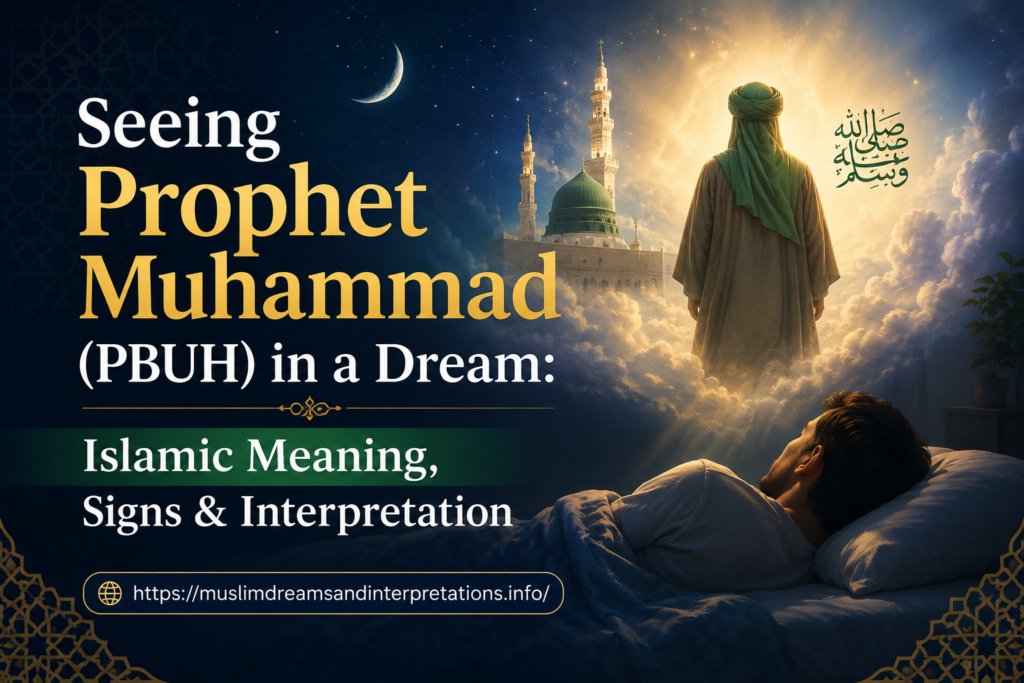
You wake up and your heart is going fast. Maybe your face is wet before you’ve even worked out why. And there’s this strange certainty sitting in your chest that something happened, even though you know, logically, you were just asleep in your own bed the whole time. Ask around and you’ll find this is almost a script — Muslim after Muslim describes waking from a dream of Prophet Muhammad ﷺ in more or less the same way.
If that’s you right now, you’re probably not here for a dictionary definition. You want to know if this actually means something, or if it was just your brain doing its usual nighttime nonsense. You want to know what to do next, if anything. So let’s get into it, the way I’d explain it to a friend who just texted me at 6am going “I think I just saw the Prophet ﷺ, what does that mean??”
One thing first, though, because it matters more than any single interpretation below: nobody — not a scholar, not a sheikh with a huge following online, not this article — can hand you a certain, one-size-fits-all reading of your dream.What follows is a blend of what is known from hadiths as well as what scholars through the ages have thought about interpreting these experiences. The two are distinct and good scholarship on the subject does not muddle them.
Most dreams, in the Islamic view, just aren’t that serious. You had a weird day, you ate something heavy before bed, your brain is sorting through junk — that’s most dreams. A dream of the Prophet ﷺ doesn’t get filed there. It sits in its own category, and it has for as long as this question has been asked, because of one specific hadith we’ll get to in a second.
But “it’s in a different category” doesn’t mean “it always means the same thing.” That’s where a lot of articles on this topic go wrong — they’ll tell you a smiling Prophet ﷺ means X and a distant Prophet ﷺ means Y as if it’s a formula. It is not. What scholars tend to agree upon is much less wide-ranging and, frankly speaking, much more reassuring: Muslims have interpreted this experience as a blessing, as a piece of good news.
Here’s the line everything else in this article hangs off. It appears in both Sahih al-Bukhari and Sahih Muslim: the Prophet ﷺ said that whoever sees him in a dream has truly seen him, because Satan is unable to take his form.
Scholars have quoted this hadith for over a thousand years, and it still comes up first in basically every serious discussion of the topic. It’s short. It doesn’t come with a manual attached. And that’s kind of the point — it tells you the dream is real and meaningful, without telling you exactly how it’s supposed to look or feel for every person who has it.
What it doesn’t do is explain how the Prophet ﷺ appears to different people, or promise that every detail carries a hidden message. The majority of scholars has admitted straight up that they do not know how exactly this works and would rather say “we do not know” than come up with some explanation. The willingness to admit ignorance is quite a valuable trait to have in one’s arsenal if one is trying to figure out their dreams.
Honestly? Sometimes you can’t know for sure. And that’s allowed.
Classical hadith preserves descriptions of what the Prophet ﷺ looked like — his build, his complexion, features people who knew him wrote down. Some scholars lean on this when weighing whether a dream lines up with who he actually was. It’s not a checklist you pass or fail, more a loose point of reference.
People also disagree on whether he appears the same way to everyone, or at different points in his life. Some dreamers describe someone younger; others describe him the way he’s traditionally pictured in his later years. Neither version gets waved off as fake.
And then there’s the version where you never really see a face at all — you just know. This trips a lot of people up because it feels like it should count less. It doesn’t. Plenty of accounts, old and new, describe exactly this: no clear image, just an instant, bone-deep certainty about who was there.
If you’re sitting with real uncertainty after your dream, don’t force yourself into a verdict. “I’m not sure, but it felt significant” is a perfectly honest place to land.
No authentic image of the Prophet ﷺ has ever existed — no portrait, no photo, nothing to compare a dream against. And when they say that one sees him “in his true form,” it is not meant that one sees his face as someone who might recognize him in real life. It means that one is able to recognize him at once with accompanying a feeling of peace or light that is difficult to describe without exaggeration.
There’s a real difference, though, between that kind of recognition and simply having a dream with a man in it who you later decide must have been him because the dream felt important. Scholars have pushed back gently on that second version — a vague figure in a meaningful dream isn’t automatically a vision of the Prophet ﷺ just because your gut wants it to be. If anything else in the dream seemed out of place or contradictory, it is okay to take that loosely as well.
To be blunt, there is no one interpretation. What exists instead is a handful of themes that show up again and again across scholarship and personal accounts, and which one applies to you probably has more to do with your life right now than with the dream itself.
Sometimes it lands as a nudge back toward the Sunnah — not a scolding, more like a tap on the shoulder. Sometimes it’s just comfort, plain and simple, arriving at a moment you needed it. For a lot of people it shows up as a swell of love for the Prophet ﷺ that they didn’t know was sitting that close to the surface. Some read it as an invitation to reflect on their own character, or as encouragement to hold on through a hard season, or simply as a pull toward doing right by Allah.
No one of these interpretations is absolutely certain, and no scholar holds this list to be exhaustive.
This is one of the more common versions people report, and in classical dream interpretation it tends to get linked to good news — relief on the way, something lightening up.
I’d hold that loosely, though. It’s a general reading, not a promise, and your own circumstances color it more than the smile does. Someone going through a hard year and someone coasting through an easy one could have the identical dream and be looking at two very different situations underneath it.
This one scares people, understandably. So let’s slow down here.
Some scholars have suggested this version can prompt self-reflection — a reason to look at your own conduct or how consistent you’ve been in your practice. That’s a fair reading, but it’s offered as one possibility among several, not a verdict. What it is not is proof that Allah is angry with you. That leap — from “I dreamed the Prophet ﷺ looked sad” to “Allah is upset with me specifically” — goes way further than anything in the scholarship actually supports. If a dream like this shakes you, the healthier move is to lean into more prayer and better habits, not to spend the week convinced you’re in trouble.
If words are involved, the words are the whole ballgame — what he says matters far more than the fact that he spoke at all.
If it sounds like something the Prophet ﷺ would actually say — patience, prayer, good character, the basics of the faith — take it as encouragement and let it move you. If something in the dream feels off, contradicts what you know of Islam, that’s your cue to be skeptical, because it may be more your own mind at work than an authentic vision.
Either way, keep this in your back pocket: no dream, however vivid, creates new Islamic rulings. Nothing you hear in your sleep overrides the Qur’an or the established Sunnah. That’s not this article being cautious for the sake of it — it’s just how every serious scholar treats the subject.
More common than people admit, and not a lesser version of the dream.
A lot of people describe just knowing — no face, no features, just certainty. It sits somewhere between a full, clear vision and something more symbolic, and scholars generally don’t rush to sort it firmly into either box. Not seeing a face doesn’t cancel out the weight of the experience. You’re still allowed to take it seriously, even if you can’t describe what he looked like to save your life.
Across a crowd. From behind. Just a shape you somehow knew was him, too far off to make out details. This shows up a lot, and nobody treats it as a smaller or less meaningful dream — just a less detailed one.
What tends to matter more than the distance itself is the feeling that came with it. Longing shows up a lot in these accounts, a sense of almost-but-not-quite closeness. Where you are in your faith and your life at the moment probably shapes how you read that feeling more than anything about the dream’s specifics does.
Dreams set specifically in Madinah, or inside Masjid al-Nabawi, tend to come with a real ache of longing — a pull toward that city and everything it holds.
Try not to read this as a booking confirmation for a trip you haven’t planned yet. It’s fine, even beautiful, to feel drawn to visit the Prophet’s Mosque — that’s worth acting on through your own means and intention. Just don’t treat the dream itself as some kind of promise that the trip is coming.
This one comes in a few flavors. Sometimes it’s a physical object of some kind. Sometimes it’s food or drink, which classical interpretation often ties to blessing. Sometimes it’s clothing, sometimes advice, sometimes something harder to categorize.
The category itself is less important; it is the thing remembered and when it happened. The vague “he gave me something” doesn’t hold quite the same importance as the vivid image. Being able to recall precisely what it was and what it felt like carries more importance than the general idea of “dreams where he gives gifts.”
In many cases, the actual conversation tends to be the most memorable part of the dream, often remembered long after other elements are forgotten. There is something about hearing his voice that leaves an impression deeper than others.
If there were any specific words that have remained with you upon waking, it is worthwhile to see how they hold up to comparison with the Quran and the Sunnah, and not to regard them as an independent message from heaven. There’s a real difference between a conversation that left you encouraged and one that seemed to be handing down a ruling — the first is a normal, welcome part of this kind of dream, the second deserves real caution, because dreams simply don’t carry that kind of authority, no matter who appeared in them.
An unusual number of these dreams get reported during rough patches — grief, illness, anxiety, loss. Scholars have generally treated that timing as reassurance rather than coincidence, and it’s easy to see why: it’s exactly the moment someone would need it most.
Whatever comfort the dream gives you is worth putting somewhere useful — more consistent prayer, a bit more patience, leaning harder into trust in Allah — rather than sitting around waiting for its “real meaning” to reveal itself.
It is easy to interpret a dream such as this one as your spiritual grade card. Most scholars push back on that pretty firmly. A beautiful dream doesn’t make you a better Muslim by itself, and it’s not a certificate of anything.
What actually matters, according to the same scholarship, is what you do after you wake up. Does it change anything? Do you pray a little more consistently, treat people a little better, hold onto the Sunnah a little tighter? That’s the real test — not the dream, but the Tuesday afterward.
People from every level of religious practice report this dream — not just scholars, not just the unusually devout. There’s no known prerequisite, no status you have to earn first.
Because of that, most scholars actively discourage chasing it. Getting fixated on trying to have this experience tends to work against the humility the experience is supposed to leave you with in the first place. Ironic, but true.
There’s nothing wrong with hoping for it, and plenty of people do — through sincere dua, through sending salawat regularly, through simply trying to live closer to the Sunnah day to day. None of that is discouraged.
What isn’t fair to claim is that any particular practice guarantees the dream. It’s not a spiritual vending machine where the right dua in, the right dream out. It remains, by every account, something that arrives on its own terms.
Start simple. Say Alhamdulillah and actually sit with the feeling for a minute instead of immediately trying to pick it apart. Send salawat. Give yourself time to reflect before you decide what, if anything, it meant.
If part of the dream clearly lines up with Islamic teaching, let it guide you. If part of it doesn’t, set that part aside without guilt. If you want to tell someone, tell one person you trust and who won’t turn it into a spectacle, rather than posting it for a wide audience. And whatever you do, don’t let it become the foundation for a big decision or a new personal rule — no matter how real it felt, it doesn’t carry that kind of weight.
Don’t panic. This happens to a lot of people, and it’s not a failure on your part.
If it helps, compare what you remember against what’s known from authentic descriptions. If something is really sitting heavy on you, ask someone actually qualified — not a random account on social media promising instant interpretations, because a lot of what’s out there is guesswork dressed up as certainty. And if you land on “I genuinely don’t know,” that’s a better place to be than confidently claiming something nobody can verify.
No, and this is worth sitting with. There’s a real gap between what’s traditionally treated as an authentic vision and something more symbolic — shaped by your own thoughts, memories, whatever’s been on your mind.
Your circumstances matter. Interpretation has real limits, even for people who’ve spent their lives studying it. And one more time, because it’s the thing worth repeating most in this whole article: none of it functions as revelation or law. The Qur’an and Sunnah remain the standard. A dream, even this dream, stays personal.
Islam also has plenty to say about dreaming of other prophets — Ibrahim, Musa, Isa, and others — and those experiences are treated with real respect too. But they don’t come with the exact same hadith backing them, the one that specifically guarantees Satan can’t imitate Prophet Muhammad ﷺ.
That’s what makes his case unique, not a claim that dreams of other prophets don’t matter. They just get evaluated on their own terms rather than automatically inheriting the same guarantee.
What is meant by dreaming of Prophet Muhammad ﷺ?
As indicated in the hadith found in Sahih al-Bukhari and Sahih Muslim, this is not a simple dream but an authenticated one, since Satan cannot assume his form. However, beyond that, the interpretation of this dream will depend very much on you and your situation.
Is dreaming of Prophet Muhammad ﷺ a good omen?
Most Muslims and scholars treat it as one, yes — though not as a guarantee of anything specific down the line.
Can Satan appear as Prophet Muhammad ﷺ in a dream?
No, according to the hadith. This is one of the rare, specific exceptions.
What if I saw the Prophet ﷺ but could not see his face?
Totally common, and it doesn’t make the experience less valid. Plenty of people describe knowing without seeing.
What if the person looked different from the Prophet’s description?
That’s exactly why scholars urge some caution about declaring certainty — a mismatch with authentic descriptions is a reason to hold the interpretation more loosely, not to write off the whole experience.
What does it mean if Prophet Muhammad ﷺ speaks to me in a dream?
The words matter most. If they line up with Islamic teaching, take them as encouragement. If they don’t, be cautious, and remember dreams can’t establish rulings either way.
Can I ask Allah to let me see Prophet Muhammad ﷺ in a dream?
Yes — sincere dua, salawat, and living closer to the Sunnah are all encouraged. Just don’t expect any of it to guarantee the outcome.
Does seeing the Prophet ﷺ assure me entry into Paradise?
Not necessarily; it is usually taken as something comforting or reassuring, rather than an indication of one’s final destination.
Am I supposed to tell others that I saw the Prophet ﷺ in my dreams?
If you tell anyone, tell someone reliable and down-to-earth rather than all the people you know.
However your dream showed up — a clear face, a distant shape, a few words you still remember, or just a feeling you couldn’t fully explain to anyone the next morning — Islamic tradition asks you to hold it gently rather than dissect it to death. It’s not proof of your spiritual rank. It’s not something to be afraid of. It’s a moment.
Where scholars genuinely disagree — and on plenty of the details above, they do — the safest move is to go back to authentic hadith and real scholarship instead of whatever’s trending on social media that week. Past that, the advice hasn’t really changed in a thousand years: be grateful, stay humble, let it pull you a little closer to your faith, and don’t feel like you owe the dream a bigger meaning than it actually gave you.
for you personally.