
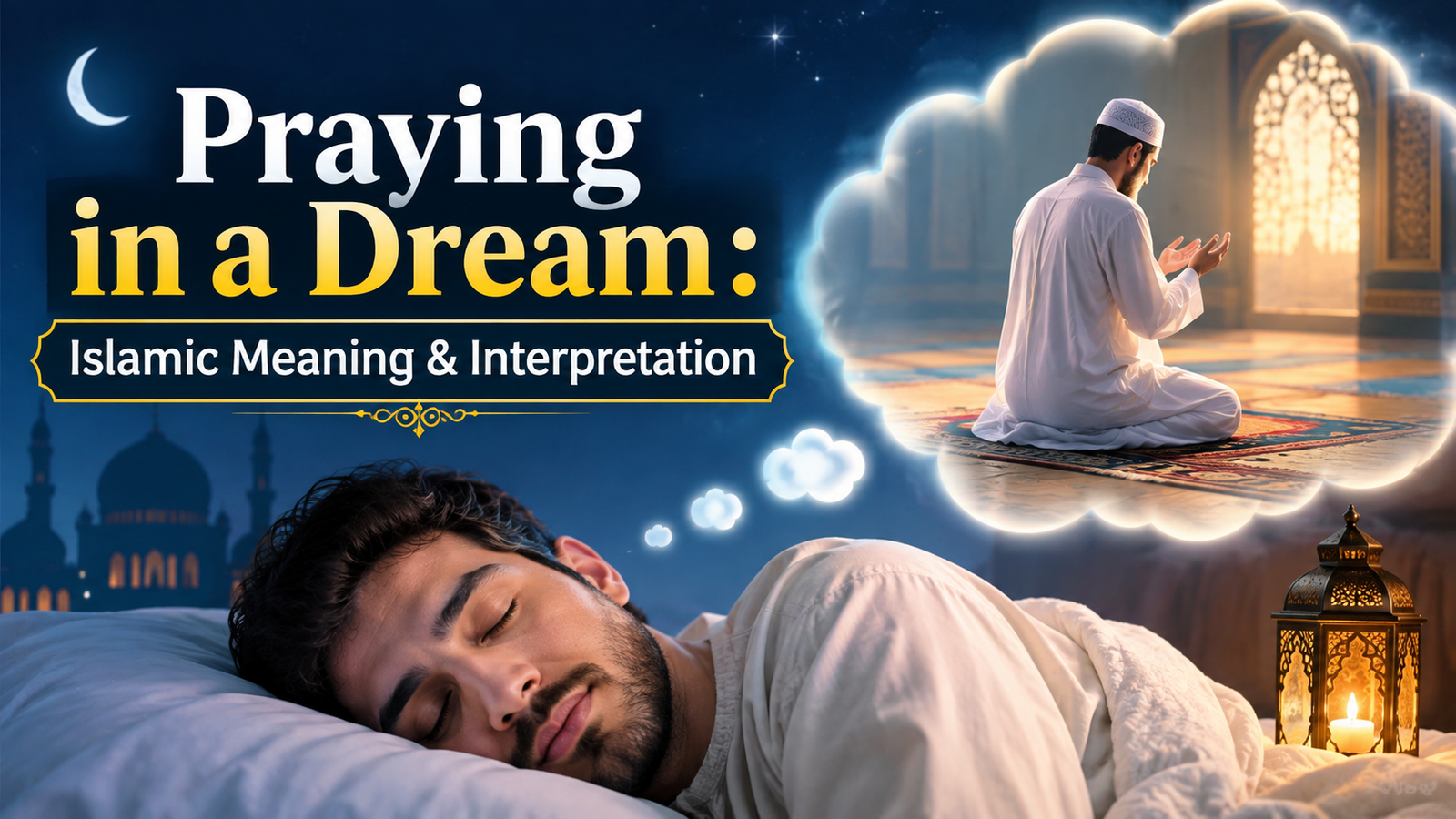
You wake up, and the dream feels more real than your room for a brief moment. You were praying, either alone, next to someone you knew, or next to someone deceased. And you lie in bed and question whether it meant anything or whether your brain simply replayed the stresses of the day in a weird disguise.
The honest truth is that Islamic scholars have been analyzing dreams such as yours for more than a millennium and didn’t view them as some kind of nonsense. However, they also didn’t see them as predictions. The truth lies somewhere between these two views, and the vast majority of online articles don’t even attempt to explain it and only offer you another neat but useless sentence. Not this one. We will analyze what the traditional teachings say, how the meaning of the dream might be different for different people, and how you should analyze your dreams.
What Does Praying in a Dream Actually Mean in Islam?
Seeing yourself or someone else praying in a dream is, in most classical readings, treated as a good sign — usually connected to sincerity in faith, relief from a burden, or guidance arriving at the right time. But that’s the short version, and the short version is exactly what causes confusion, because it makes the interpretation sound fixed when it never was.
Where This Interpretation Comes From
If you’ve done any research on this topic, chances are that the first person you would encounter was Ibn Sirin, an eighth century scholar who made observations that formed the basis of an entire branch of knowledge called Ta’bir al-Ru’ya, or basically interpreting your dreams from an Islamic perspective. Typically, Ibn Sirin associated acts of worship in a dream whether it be Salah or some dua, with things such as strengthened faith, forgiveness, or a solution to a problem.
Now comes the part where people tend to neglect it – most of what is available on the Internet pertaining to this topic has not been written by him. Scholars in manuscripts have made this point clear many times before. The text is written, rewritten, translated incorrectly, and re-attributed till all that you read in the name of classical interpretation becomes nothing but folklore under Ibn Sirin’s name. Does it make the tradition useless? Not at all. It just makes you more cautious about dream dictionaries.
Why the Same Dream Means Different Things for Different People
Now it gets interesting. Dream about praying is not a symbol in which you would look up the meaning in a glossary. Three factors almost always change its interpretation: who was praying in the dream, emotions associated with praying and real-life situation of the dreamer. A person experiencing some difficulties and a happy person can have almost the same dream and understand its meaning completely differently.
The following comparison gives a clear idea of how three popular ways of interpreting such dreams differ:
| Approach | What It’s Based On | Where It’s Useful |
| Classical scholarly tradition (Ibn Sirin-linked texts) | Centuries-old written sources, though often mixed with later additions | Understanding the historical symbolism behind the dream |
| Modern Islamic counseling perspective | Applies the old symbolism to the dreamer’s actual circumstances | Personal reflection and emotional processing |
| Random online “dream dictionaries” | Mostly uncredited, recycled content | Curiosity only — treat with caution |
A Practical Way to Actually Interpret Your Prayer Dream
Instead of trying to find one meaning that suits your dream, it makes sense to go through the process in the form of a quick check-list. Islam dream interpretation was never supposed to be applied blindly, so treat it more as a list of questions to ask yourself in a certain order.
Step 1: Who Was Actually Praying?
This is the ultimate fork in the road. Seeing yourself praying in a dream is considered to be a symbol of inner harmony, sometimes it serves as a gentle reminder to go back to religion that you have forgotten. Seeing someone praying in a dream —your friend, parent or even stranger – is most likely a reflection of your desires and concerns towards them rather than the actual feelings of the praying person. For example, if you saw your father praying in a dream, most likely this is not about your father but about your hopes for him or fears about something you may lose.
Step 2: What Kind of Prayer Was It?
However, not all prayer dreams are alike, and the kind of prayer matters. Seeing someone praying namaz in a dream — the ritual prayer performed with certain gestures – in a dream is a symbol of faith consistency and collective blessings, especially if it takes place in the mosque. Dua, which is performed more quietly, holds more individual significance. Knowing which one of them it is, you are half done with your interpretation.
Step 3: Did a Prayer Mat Show Up?
It is common for small elements within dreams to be the first things forgotten; however, it should be noted that small elements of a dream do a lot of the interpretive heavy lifting. Seeing a prayer mat in a dream in Islam — especially one that’s clean, new, or well cared for — is normally associated with the concepts of sincerity and a healthy relationship to worship. Alternatively, a prayer mat that is old, torn or in some way unusable suggests the opposite: neglecting duties or putting them off until a later date.
Step 4: Was the Person Praying Someone Who’s Passed Away?
This tends to feel different, and rightfully so. Seeing a dead person praying in a dream in Islam is one of the more emotionally loaded variations, and it’s usually interpreted as reassuring — a suggestion that the person is at peace. Some scholars go further and read it as a gentle prompt for the living to increase their own dua or charity on that person’s behalf, almost like the dream is asking something of you rather than just informing you.
Step 5: Sit With It Before You Act On It
When you interpret the dream, do not rush to judge. Islamic tradition generally treats dreams as guidance, not prophecy. If the dream is tangled up with a real decision you’re facing, praying Istikhara — the prayer specifically meant for seeking guidance — is a far more grounded next step than trying to reverse-engineer a prediction from a few blurry images you half-remember. And if the dream keeps repeating, it’s worth talking to someone who actually knows the subject rather than a random blog.
Where People Get This Wrong
A few mistakes come up constantly. The first is treating any interpretation with “Ibn Sirin” attached to it as automatically authoritative — as mentioned above, a lot of that material is unverifiable at best. The second is assuming a prayer dream is always good news; context can flip the reading, and pretending otherwise does a disservice to how nuanced this tradition actually is. The third, and probably the most overlooked, is ignoring how the dream felt. Two people can dream the exact same scene — someone praying quietly in a dim room — and one wakes up comforted while the other wakes up unsettled. That emotional residue often tells you more than the literal picture does.
Common Questions People Ask
What does it mean to see yourself praying in a dream?
It’s generally read as a positive sign — often tied to sincerity in faith or a subtle pull back toward religious commitment you might have neglected. Some interpreters connect it to a period of seeking direction in life. How closely you take this to heart should probably depend on how consistent your actual worship has been lately, not just the dream itself.
What does seeing someone praying namaz in a dream mean?
It typically points toward blessing, steadiness, or communal faith connected to whoever was praying. If it was a stranger, some interpreters treat it as more of a mirror — reflecting your own spiritual hopes rather than saying anything about the stranger. The setting matters too; a mosque carries different weight than an open field.
What does it mean to see a dead person praying in a dream in Islam?
Most interpreters treat this as comforting — a sign the person is at peace. It’s sometimes also read as a quiet nudge for the dreamer to give charity or make dua on that person’s behalf. How the deceased person looked and behaved in the dream — calm versus distressed — tends to shape which reading fits best.
The Bottom Line
However, the symbol of praying in a dream is not one rigid sign that will be interpreted for once and forever after. It is dynamic and depends on the identity of the person praying, the form of prayer and the events of your real life. Instead of finding an abstract solution, go deeper into the details and if the meaning of the dream keeps bugging you, turn to Istikhara or consult a wise person rather than guess about the meaning of your dream.
For further research: If you find the theme interesting, the whole guidebook on interpreting dreams from an Islamic perspective (Ta’bir al-Ru’ya) is recommended to read next as well as the symbolism of dreaming of mosques.